Sunday, 30 October 2016

Thinking about scale

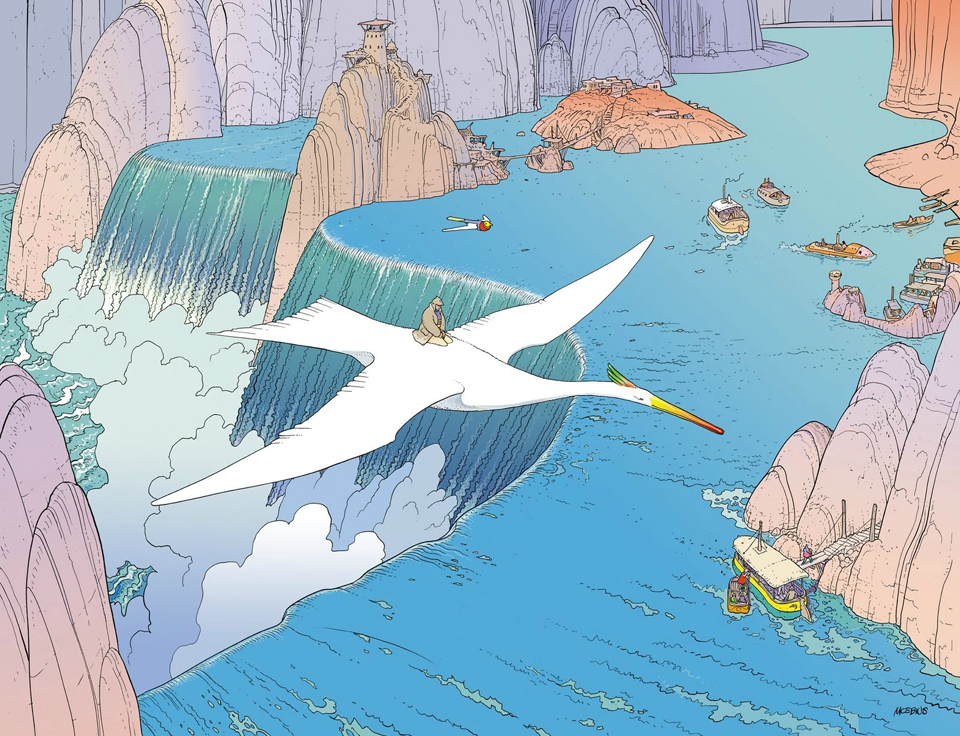
Image result for moebius landscape

I'm enjoying messing about with scale and perspective in composition because it feels like a learning curve for me, the more I do the stronger the visuals in my mind get. Roughing is always really useful to me in terms of refining an idea down to its core principles and trying to capitalise on them. Ive started moving away from JUST character based illustration in my research, and illustrators who make use of sprawling landscapes (like Moebius, above) and make the environment feel like a character within the image, rather than an afterthought background. This is something I'm trying to understand through my roughs as I think it really makes for compelling compositions with multiple visual levels.


Tuesday, 25 October 2016

Progress Crit - Group Feedback


  • Think about using a combination of print techniques - lino altered digitally and screenprinted?
  • Make little models for the puppet theme designs
  • Isometric perspective
  • Persian perspective
  • Look at architecture and maps - repeat patterns to make background
  • Artists: Mondo, Ian McQue, Nico Delort

Mondo: start thinking about colour and colour limitations, how to use block colour and texture combined to accentuate the key elements of prints
Image result for mundo illustration

Ian McQue: think about scope, if I'm doing wide expanses it has to be convincing and grounded in reality or it will look jarring when all the elements come together
Image result for ian mcque star wars


Nico Delort: Shakespeare is largely fantasy, I need to ground my ideas in fantasy - consider the environment as a character too
Blend elements of fantasy with the visuals of reality - realistic scale and distance etc

Image result for nico delort

Image result for nico delort

Friday, 21 October 2016

AD&D Briefs first thoughts & breakdown

BBC Edinburgh Festivals

  • Capture the spirit of the events for those who can't attend
  • BBC at the forefront - experimental technology
  • Make use of the millions of people at the festival
  • Bring it into people's homes + pockets 
  • Convey the nature and themes of the festival to those who want to attend but cant for whatever reason
  • Something unique to the BBC as a brand

Desperados
  • Music + purpose
  • Experiential + inspire physical participation
  • Think about spaces that bring people together - will you create a whole new event or tap into existing ones
  • How can the idea be bigger than the physical space
  • House Party Unplugged 
  • Groundbreaking but grounded
  • Avoid cliched Mexican themes 
  • See Rules on Responsible Commercial Communication
  • Music + positive change
  • Similar: Age UK, Oxfam, Coca-Cola Share A Smile

Hasbro
  • Party game for young adults
  • 16 - 26 year olds 
  • Not too edgy - no drinking :(
  • Reimagine or subvert existing media/games
  • There are loads of variations on Bop It/Monopoly/Risk etc, could look into that
  • Self contained - no app or screen or anything needed to play
  • Nail the big idea but theres room for craft 
  • How to position and promote your game
  • Strive for uniqueness
  • Keep it Simple 

John Lewis
  • Be true to the brand 
  • For time short urbanites - value newness and unique products
  • More than just shopping - aspiration, inspiration & more often than not an experience
  • Avoid retro route - modern, looking forwards
  • Think beyond just the stores themselves
  • Don't focus on London - needs to be accepting to everyone
  • Research into what people get out of John Lewis
  • Context is key
  • Realistic but not boring
  • About building relevance - not profit

BRIEF B-B-BREAKDOWN
  • Trying to ascend from just shops/products - socially relevant experiences
  • Interactive - people based - research needed as I don't know what normal people like 
  • Realistic aspirations - nothing mental and unachievable (well, nothing too mental)
  • Simplicity is key, nobody can be bothered with a complicated interactive shopping experience
  • Avoid cliches - whatever I think of straightaway needs to be dismissed or heavily developed
  • Spirit of the event (BBC) - I go to a lot of gigs and music/performance is a big influence of mine so I think I'd enjoy that and have the mindset to make something engaging
  • Connecting people all the time - does an app have to be developed? Don't fully understand how that kind of thing works 
  • Look at reinvention first to see what is successful and what isn't - and importantly, what was successful but isn't anymore
  • Beyond shops to other physical places people can interact in
  • Try to be consistently realistic without being boring
  • Focus on spaces that bring people together - gigs/cinemas/rallies/talks/lectures/sports etc
  • Capturing the nature of the brand - the feeling of Edinburgh Festivals through the eyes of a performer or member of the audience, the experience of shopping at John Lewis (and taking out a mortgage to buy a christmas tree)
  • Re-write and challenge the brief 

Thursday, 20 October 2016

Printed Pictures - initial ideas

I'm excited to be able to properly play with scale and depth of frame in this brief, as for the editorials we had to cram our ideas into those little boxes, but the bigger scope of this brief is great because it feels a lot more open to interpretation. 
After looking at concept artists like Moebius and Ian McQue, I'm definitely heading in a cinematic direction with the composition of these prints. I'm used to doing character work so I want to step outside that and really start to consider a characters environment and how they would behave within it, instead of them just existing in a void.


Tuesday, 18 October 2016

Progress Tutorial notes - Ben

It was good to check in today and make sure I'm going forward in a good way with this module as a whole, I always worry loads so I think I need to stop wasting time doing that and get on with just making bare stuff.

  • Explore narrative - book illustration, film posters - pictures that have a specific story to tell
  • Be open minded to process + depth of line with materials - branch out
  • Try the Wacom tablets - shift into digital
  • Comic book covers? fits with ideas of making Shakespeare for everyone rather than elitist
  • look at loads of comics and graphic novels (CAN DO)
  • underground publishing - BOOM!Studios, Image, DarkHorse etc
  • Chura markers, big bastard graphite pencils - break out of conventional way of working
  • FOCUS: sequential, narrative, character, dramatic scenes

Editorials - Shakespeare everywhere


This has probably been my strongest idea since the start of this brief and I'm happy to have properly realised it here in finished form. The characters here are what I wanted to do with character when we first started the zine, not too much detail but expressive enough to get across their natures visually. I actually really enjoyed playing digitally with the colour on all three of these, I'm not usually very confident with digital work, but it's something I'll have to do so I tried to just sort of jump into it here, and I think it's worked out alright. 

Editorials - OUT DAMNED SPOT


I wasn't sure that I was fully on board with this idea at first as I had to return to my original 60 drawings to get ideas for this format, it was definitely the most difficult for me to adapt to. The simplicity of it has worked quite well though I think, but I might tamper with it before hand in because something about it still seems unfinished to me. One thing I feel has worked here are the colours, I didn't want to overdo it with the red so I incorporated different tones to bring down the boldness. 


Editorials - The Stage


I think this is my strongest use of composition as I drew it quite big on a3 and shrank it digitally while adding colour. This method helped me create a much more detailed image and focus on arranging everything in the frame rather than worrying about how to waste time colouring it using analogue media. People in the crit found it theatrical and dramatic, which is what I was going for, especially with this editorial, through the heavy use of block black at the forefront of the image. 


Final six Feedback

I think that I've got a solid direction with my editorials now, I've started to add colour to each idea and started thinking about how to finalise them. A few last bits of feedback today were:
-Keep red and black as the colour pallette, it's immediate
-Use Shakespeare on the stage as a final, clock idea isn't really clear
-Rethink the landscape editorial with ideas from earlier on, simplify instead of having too much going on 
-Multiple Shakespeare's works well, just needs refining. 


Monday, 17 October 2016

Editorial Illustrators - Marco Goran Romano


Visual Language
Image result for marco goran romano variety
Marco Goran Romano is an Italian illustrator/graphic designer who uses highly stylised, cartoon inspired vector designs to create editorial work with subtle hints at social and political themes. His work doesn't feel aggressive or politically charged, but more of a humorous look upon and deconstruction of the value we place in certain silly things as a society. As I'm starting to get very much involved with politically loaded material in Context of Practice, I want to keep things lighter in my work for this module or I might slip into madness. Shakespeare has a lot of very dark material in his plays, but I want to try to deconstruct it all a bit and poke some fun at the man himself, as his work is so ridiculously famous, the human element of him writing it often feels very far removed from the fame to me.
This thematic approach to my own editorials is what lead me to Marco's illustrations. They appear smooth and light, with perfect edges and flat colours, but connote a spark of attitude and comedy about them. Especially in the above editorial produced for Variety Magazine, the imagery of the snow globe makes me feel a suggestion that he as the author of the piece, is subtly mocking the drama of this year so far, by miniaturising it and containing it with this visual metaphor of a quaint little desk toy. While addressing relevant issues and social events, I feel Marco is simultaneously sort of saying "okay, this is what happened, but it's over now, put it all up on the shelf and shut up about it". This strong sense of authorship is present throughout his work, and is inspiring in relation to editorial work, as so much of it can be indistinguishable in its attempt to be edgy and thought provoking. Marco's simple approach with that bit of a smirk behind it goes much farther, I think, into making us step back from whatever it is we are reading and take a minute to laugh at ourselves. Which is always good.


Creative Process
Image result for marco goran romano variety
Digital alteration of my work has been really important for the development of my editorials, as we've been forced to work digitally for the requirements of the brief. It's been good practice in regards to how we'll need to be able to shift and adapt when we're working, depending on the presets of a brief or a client, and I feel a lot more confident working digitally than I ever have. I think the main contributor has been to stop telling myself to avoid it because I was bad at it, but telling myself to get better at it because I was bad at it.
Marco's work thrives in the digital medium, as it is so connected to the millennial mindset in its sharp visuals and block colours. This visual immediacy works great for editorial work, as it's eye catching whilst not being a massive overpowering painting about oil spillage. It hits the middle ground of being engaging without being abrasive, when placed in the context of an article/website.
The illustration above featured in GQ Magazine in Germany, and I think it perfectly captures the tone of that magazine, with a dash of comedy to bring it back to earth. The tools immediately relate to the manly man totally masculine dude man tone of GQ, and the iPhone immediately works as bathos to that, and feels like a little nod to the metrosexual generation. I mean, I'm a grown boy and I don't have a spirit level OR a spanner in my house, but I have an app that plays little bits of Daft Punk songs when you tap a green keyboard. THE FUTURE IS NOW!
And Marco Goran Romano is embracing it with open arms.

Editorial Illustrators - Esther Aarts

Visual Language
Esther Aarts (brilliant name for an artist) is an illustrator from the Netherlands, whose work exists primarily in postcard/poster format. She does a lot of editorial work, and her strong composition lends itself well to this as she can format her imagery into different specified measurements and situations.
The figures in her illustrations are often in motion, her fluid drawing style creating a lively atmosphere within her work. This visual aspect is what really appeals to me about her illustration, as I've been trying to solve the problem of creating a dynamic composition with consideration for a pre-determined format (the editorial measurements). Her work doesn't feel in any way constrained by the limits of editorial measurements and postcards, and this ability to transcend its borders is something I want to explore in my own designs.
Her general style reminds me of old Disney cartoons, specifically the 1950s shorts with bouncy animation and fluid character designs. Most of those cartoons didn't have any dialogue in them, and focused on the visuals to convey the message. Esther's work works well to do the same thing in a modern context, in explaining quickly, simply and comically, any article it's produced for.
Image result for esther aarts editorial


Creative Process
The vintage style of Esther's designs are reinforced by the method by which she creates them. She hand letters most of the typography she uses, and the majority of her work is made using a letterpress. While looking for examples of her old school methods I found that for her last collection of postcards, titled Pushing Your Luck, all her postcards were made with a process called mimeograph (or 'Ditto') printing. I'd never heard of this so I looked it up and found that its a method invented in 1923 that involves a large pressing machine that uses stencils and fibre sheet to press ink into the desired material. It was mainly used as an early way to print copies of things (newspapers, contracts, messages etc), but became mostly obsolete once early photocopiers became invented after WW2.
This blend of her modern design methods coupled with her old school printing methods, and her retro visual style, makes for memorable and unique work that has a personal touch.
I'm really invested in work that isn't mass produced digitally, and where no two prints are exactly the same, as I think it shortens the gap between artist and audience, with a human touch rather than owning just one of millions of something printed in a factory by a third party. It was mainly this reason I found Esther's work inspiring, as a lot of editorial work can be samey and trying to be current and relevant, but this is an illustrator who is all about the craft of an idea, rather than trying to commercialise it, as a lot of editorial artists can do.
Image result for esther aarts editorial


Saturday, 15 October 2016

Progress Crit Peer Feedback

Feedback
I was surprised how much feedback I received as I wasn't really sure which of these developed drawings were successful or not. But the feedback has been really helpful for me determining where I want to take this work next:
Positive:
Characters are strong 
Composition works well
Clear layout/message
Improvements:
Start considering colour
Stay away from type 
Play with the size of things in the frame for more dynamic composition 
Going forward:
We now have to streamline these sketches further into six final ideas, two for each format. I want to properly start considering which colours best bring out the tone of my editorials, as colour is something I can often leave to the last minute, but here I need to have colours in mind before I start on the final designs. 
I'm also going to move my compositions around to compare different ways of presenting the image inside the small frame we've been given. 


Friday, 14 October 2016

Sixty drawings crit

I found today's crit really useful, I think because I'd done so many small ideas in preparation that I found it difficult to sift through them and find which ones I thought might actually work when developed. Seeing where everybody else's work is going is always interesting and helps me get a handle on what I'm trying to do, because I feel when you're sat in your room doing half a hundred drawings it's easy to get lost in your own thought process and become unable to stand back from what you've done. But hearing the groups ideas and suggestions has definitely helped me streamline my ideas, they decided I should go forward with the simplified character designs, and not get caught up in doing loads of type, the brief is for editorial images anyway so type wouldn't be necessary and probably would just be confusing. My strongest ideas were probably the many Shakespeare squad, and the drawings in which I tried to play with the composition or perspective. In small frames like these I'm used to feeling a bit boxed in and going for quite simple vignette work, but I want to step away from that and use composition to imply a larger world outside the frame of my illustration, to imply the vast reach of Shakespeare's work and just to try and give my own work some depth. 


Sunday, 2 October 2016

Moebius Research


On looking at what Ive done so far, Ben recommended to look at an illustrator called Moebius, whose work I didn't realise I had already looked at a bit last year in visual language. I really love his work because it is all set in these vast sprawling expanses of locations but at the same time they are still very focused on a small character that brings the scene to life. This is an idea I'm loving at the moment as Shakespeare has this slew of plays set all over the world in Italian cities and magical forests and the Scottish moors, but what connects all these things in my mind and drives my interest in them is the characters that populate them. I really love his use of muted colours contrasted with spots of vibrancy, each use really helps highlight the driving force of the image and the nature of each little character. Compositionally, each illustration has a grand sense of scale, which is something I want to be able to utilise in my own work, as I find my work can sometimes be too flat and vignette-ish to be that interesting. Image result for moebius illustrator

Image result for moebius illustrator

Saturday, 1 October 2016

Zine further ideas

Working in A3 has been a bit of a challenge for me as I'm used to trying to finish lots of small pieces of work rather than just one large one. So working on these larger drawings in a3 has been different and hopefully good practice for having to do larger work in the future. I'm trying to further capture these characters personalities without over explaining them, and I'm rereading Macbeth to get a more basic feel of what the core of each of these characters is, and how I can get those themes across visually.